
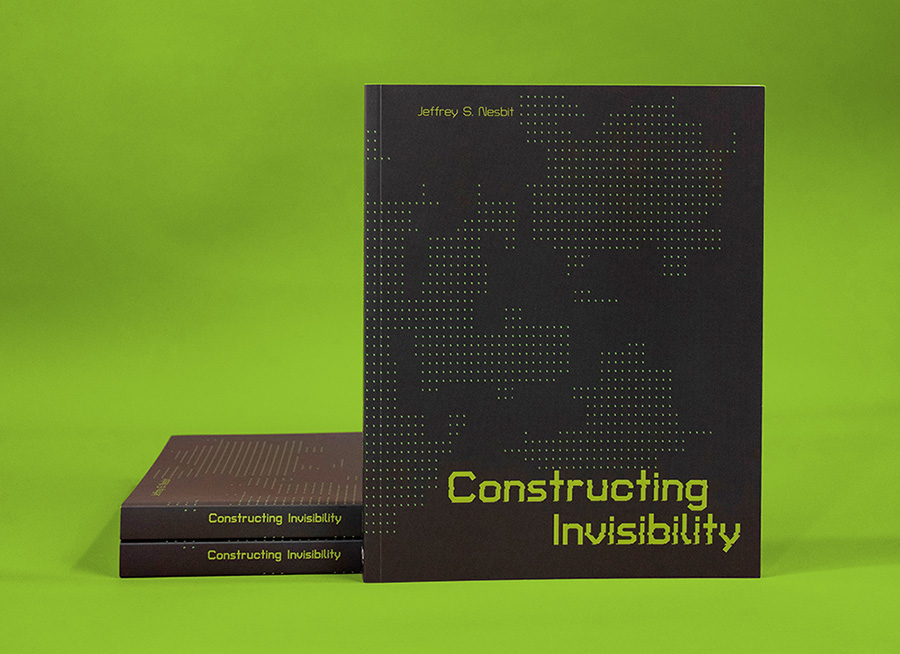
This event introduces the latest book Constructing Invisibility (ORO, 2025), edited by Jeffrey S. Nesbit. The book includes work from across diverse disciplines at Tyler and beyond, to discuss critical histories of infrastructural urbanization, planetary urbanism, military-industrial complex, Cold War geographies, nuclear landscapes, technical lands, and extreme environments. Students, faculty and staff from all Tyler departments are welcomed and encouraged.
Book Brief
Today, designers, researchers, and scholars must responsibly engage the entangled networks and delineated systems far beyond boundaries of typical design practice to engage in thoughtful critique of the past and consider counter-imaginations of the future. The late French philosopher Bruno Latour reminds us that politics has always been oriented toward objects, stakes, situations, material entities, bodies, landscapes, places change the territories and you will also change the attitudes. Illuminating stories and places has become the aim of this volume, and shedding light on distant territories has become confounded by extremity, complexity, disparity, and secrecy. Constructing Invisibility uses these economies, landscapes, and places, including the boundless corporations and destructive climate realities, to better see the world. Further, the collection of essays seeks to understand how the construction of such sight impacts civilian occupation in the urban and extra-urban realm.
With contributions from
Pedro Ignacio Alonso, Ryan Bishop, Keaton Bruce, Randy Crandon, Lindsey Freeman, Philip Glahn, Gretchen Heefner, Ghazal Jafari, Eliyahu Keller, May Khalife, C sar Lopez, Jeffrey S. Nesbit, Hugo Palmarola, Victoria Sanger, Malkit Shoshan, Mark Stanley, Charles Waldheim, Dongwoo Yim