
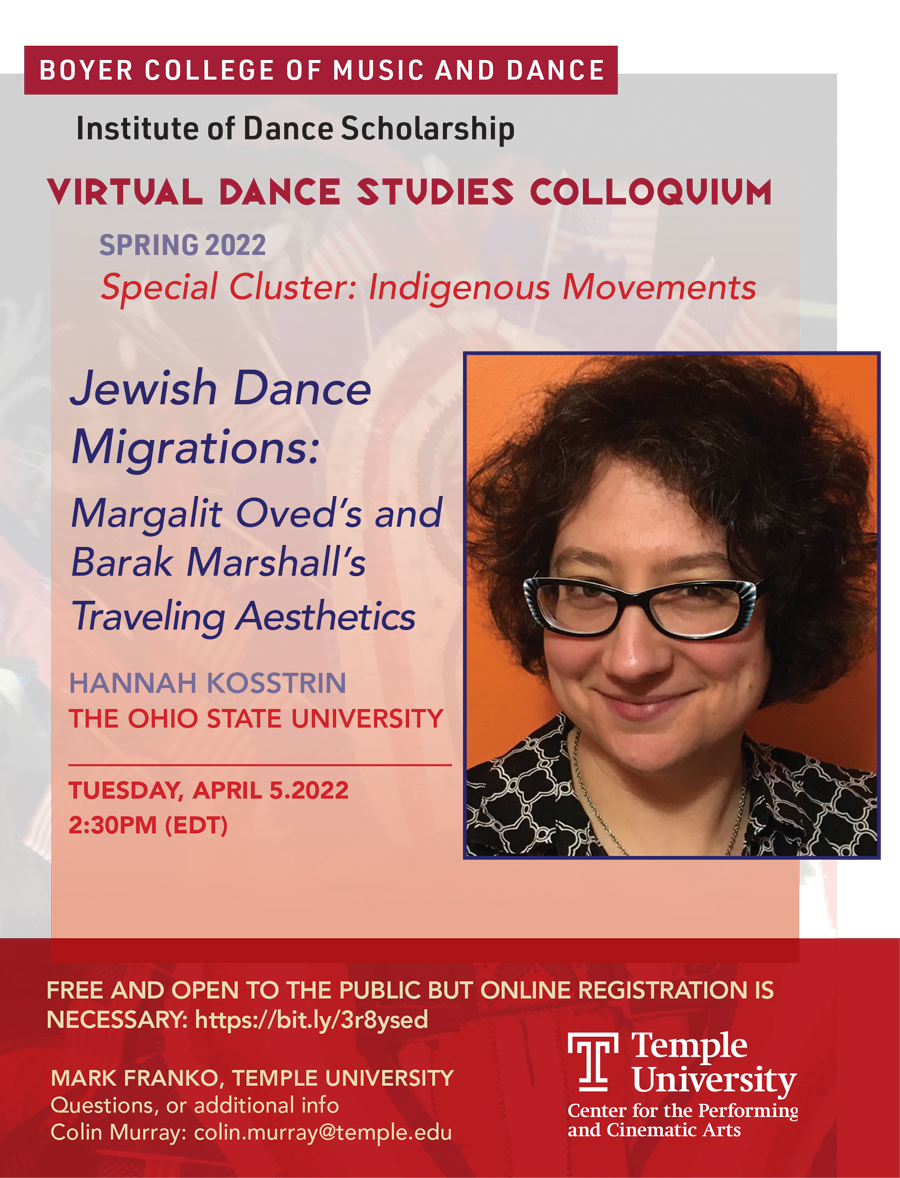
The politics of Jewish ethnicities and aesthetics have migrated through dance performance between Israel and the United States since the mid-twentieth century. In this talk, Kosstrin discusses the work of Yemenite-Israeli-American choreographer Margalit Oved and her Yemenite-Ashkenazi-American son Barak Marshall between the 1970s and the 2010s to show how the ways Arabic Jewish dance aesthetics travel tell dual stories of belonging to and exclusion from the transnational Jewish diaspora. Oved s and Marshall s dances embody kinesthetic evidence of cultural migrations connecting India, Iraq, and Yemen to Israel and the United States. By historicizing Jewish dance migrations in this way, Kosstrin recalibrates Ashkenazi (European Jewish) dominant narratives about how Jewish cultures travel and common perceptions of Jewish dance aesthetics on the concert stage. Kosstrin posits that conceiving an aesthetically broad Jewish diaspora is a first step toward fostering intra-diasporic Jewish solidarity.
Dr. Hannah Kosstrin is a dance historian and movement analyst working across dance, Jewish, gender, and diaspora studies. She is Associate Professor of Dance at The Ohio State University and affiliate faculty with OSU s Melton Center for Jewish Studies and Slavic Center. Her monograph Honest Bodies: Revolutionary Modernism in the Dances of Anna Sokolow (Oxford University Press, 2017) won Finalist for the Jordan Schnitzer Book Award from the Association for Jewish Studies, and her article Whose Jewishness? Inbal Dance Theater and Cold War American Spectatorship (American Jewish History, 2020) won the Gertrude Lippincott Award Honorable Mention from Dance Studies Association. Kosstrin served on the Studies in Dance History and Shalvi/Hyman Encyclopedia of Jewish Women editorial boards, and on the boards of directors of Dance Studies Association, Congress on Research in Dance, and Society of Dance History Scholars.
Center for the Performing and Cinematic Arts // Boyer College of Music and Dance
OPEN TO: Public